Is Globalisation Good For The World?
(05/2025)
Background
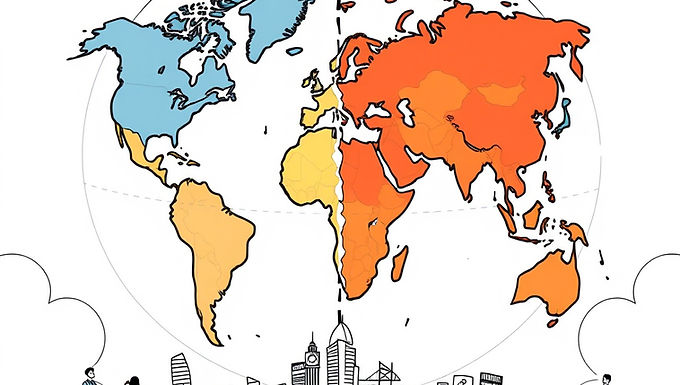
Globalisation refers to the increasing interconnectedness of nations, international businesses, and international consumers. It can be argued that globalisation started with the development of the silk road, as far back as the 1st century BC. However, silk was a luxury good, traded in low volumes, making up a very minimal portion of GDP. However, trade routes were established, and this practice of international trade would develop into the spice routes between the 7th and 15th centuries, which introduced transportation over sea, rather than land. Still, these remained luxury products, traded in too low volumes to substantially contribute to any economy. Nevertheless, global trade grew in prominence and pushed Europeans into the Age of Discovery between the 15th and 18th centuries, building empires. While these exploitative colonial economies meant Europeans made many new discoveries in raw materials like chocolate, and grew in wealth by trading with each other, economists consider this mercantilism, rather than globalisation. Thus, globalisation truly started in the 19th/20th century; however, parallels can be drawn between its current and previous forms when examining its equally significant benefits and drawbacks including economic growth, discovery, innovation, inequality and exploitation, as the phenomenon of countries growing more interconnected started over 2 millennia ago. I will be evaluating these factors to determine whether globalisation is beneficial for the world, and how it could be restructured and improved.
Positives and Negatives of Globalisation
The most obvious benefit of globalisation is the potential for economic growth. With a more efficient and consistent transportation systems across the world, products can reach more areas and more people. This provides businesses with a wider customer base, boosting sales and profits, especially following the internet’s explosion allowing instant worldwide communication and order-placing. For example, Apple operates in over 150 countries with about 58% of revenues coming from outside of the US (where it is based).[21] Firms can also extract greater profits by enhancing globalisation for greater efficiency. As products can be transported, so can raw materials and different parts of a product, allowing companies to outsource for the cheapest and most efficient method of production, reducing costs, and so maximising profit. Again using Apple as an example, it worked with suppliers in 43 different countries for components required to build its iPhone X range.[17] These increased profits can allow companies to reinvest funds, leading to further innovation and future returns. Benefits also carry through to consumers, who can take advantage of cheaper prices and better products, to enhance their quality of life.
Similarly, globalisation has allowed people, companies and banks to widen their research into global investment opportunities. This can be seen in Figure 1, with Foreign Direct Investment rising from 12.36 billion in 1970, to 3.11 trillion in 2007, before being affected by the 2008 Financial Crisis and then COVID-19.[25] FDI contributes to economic growth by financing work in the recipient country, while the investing country can plant their footprint on an international market. In 1997, Intel’s investment into Costa Rica, via investment into land, capital and labour, created jobs and paid over 2000 wages, lead to significant economic growth in Costa Rica, as seen in Figure 2, with Intel’s contribution to Real GDP growth reaching 5% in 1999.[11] Furthermore, FDI into a developing country can have additional benefits, as knowledge and technology are transferred to the developing country, with some recipients receiving employee training, increasing the skill of that nation’s workforce. Sometimes these benefits are nullified by the transnational corporation if they decide to send their higher level employees, generally involved in management, from different areas to work in the new plant/factory in the developing country. Ignoring this, in the long run, FDI should, in theory, allow people in that nation to build their own businesses, and contribute to their country’s economy directly.


However, whilst these practices of outsourcing and FDI can lead to cheaper products and increased profits for people and businesses in developed countries, there are issues revolving around the topic of exploitation. Certain forms of FDI result in developing countries donating control to more wealthy nations and companies, whilst also giving considerable financial concessions, harming their environment, and potentially damaging their future economy. Meanwhile, the prospect of a more skilled workforce has limited benefits for the recipient nation, as workers are often tied to exploitative contracts, leaving them without the funds or time to invest into their own business. Moreover, if they were to build a business using skills taught by a company investing in the region, they would most likely build a business in the same or similar sector, in which case the larger company has the financial power and influence to outcompete the local business on every front. This issue is the same for existing local companies as a negative externality. As they struggle to compete with the transnational corporation for consumers and employees, their revenue falls. Then, if the local company is not absorbed by the transnational corporation, it must consider going out of business. Additionally, developing countries generally also have laxer laws regarding worker’s rights, allowing profit driven transnational corporations to take advantage by paying employees, sometimes children, below a living wage, providing minimal or no benefits, for long hours in poor conditions. Many of these practices were examined in Jeff Ballinger’s report into Nike’s sweatshops in South-Eastern Asia, documenting the abhorrent conditions endured by the cheap labour force, while being prevented the right to start independent labour union.[1] Thus, globalisation has created many opportunities for unethical practices, which are detrimental to the state of the world.
Nevertheless, developed and developing nations alike can work together thanks to globalisation. Innovation can come directly from globalisation, as interconnected countries allow for the world’s greatest minds with varying perspectives to collaborate on research and development, furthering humanity. For example, CERN, based in Switzerland, has 24 member states, international co-operation agreements with 45 other countries, and scientific contacts in a further 22 countries, all working together to further our understanding of the universe.[3] This form of research leads to innovation and so stimulates economic activity, in all participating nations, helping dissolve international inequality.
Thus, through ethical and unethical practices, it is undeniable that globalisation has led to economic growth, visible in Figure 3, showing that overtime, as countries grow more interconnected via globalisation, the global economy has experienced significant growth, from a GDP of 11.07 trillion in 1960 to 93.35 trillion in 2023.[29] When comparing the pre-war, pre-globalisation era to now, we see in Figure 4, economic growth contributing to us having considerably less extreme poverty, more democracy, better education, more vaccinations, more literacy and less child mortality. However, the role played by globalisation in these improvements is up for debate, as all factors, apart from vaccinations, seem to be on the rise before globalisation truly started; still all improvements seem to have been accelerated. Most economists believe that globalisation started near the end of World War II, in 1945. Around this time, we do see extreme poverty and child mortality decreasing at a faster rate, and literacy and basic education increasing at a faster rate. Meanwhile, the research and action taken by medical professionals, made possible by globalisation, allowed the first vaccinations against diphtheria, pertussis and tetanus to be introduced.[20] As for democracy, although it also experienced improvements around the same time, this can be attributed to the fall of the Nazis, and subsequent dictatorships in Eastern Europe. Still, clearly, economic growth derived from globalisation has been a good for the world, allowing the average person to live better, longer lives.


However, in today’s world, these benefits are increasingly marginal, while the detrimental aspects of economic growth and globalisation are highlighted. For example, due to the economic growth caused by globalisation, there is an increased aggregate demand, and demand for a comfortable life. For example, exotic fruits that we are unnaturally accustom to having available year round, like mango’s, having an average of 4,565 food miles to reach the UK, requiring considerable transportation and so carbon emissions.[7] This then involves demand for certain goods and practices, such as fossil fuel usage, deforestation, and fracking, that are detrimental to the environment, increasing. This negative development can be seen in Figure 5, with the relatively consistent increase in carbon dioxide emissions from 5 billion metric tons in 1940 to about 37 billion metric tons in 2024.[26]

Furthermore, economic growth involving an increase in aggregate demand causes inflation, increasing the cost of living for everybody, and damaging the quality of life of the less wealthy who cannot afford to spend their savings to maintain their lifestyles. However, economic growth from globalisation also involves an increase in aggregate supply, increasing the world’s output potential, offsetting inflation caused by the increase in demand. Thus, the inflation we see in many economies today cannot be blamed on globalisation, and are rather caused by other factors, often political. As seen in the spikes in Figure 6[18], starting in 2016 and 2020, some causes of inflation include COVID-19, and Brexit, which was a decision made by the UK to become less interconnected, going against globalisation. So, if anything, high income countries, by introducing international competition and supply for goods and services, globalisation helps keep prices at a sustainable level, preventing the growth of inequality within nations.

On the other hand, globalisation has led to inequality in HICs in other ways. For example, with the rise of outsourcing, and international markets, many locals are put out of business, leading to a loss of jobs and wages, damaging local economies and the locals’ quality of life as they lose their source of income, and must either use up their savings, potentially sacrificing a comfortable retirement, or go into debt, or change their lifestyle to be more frugal. In practice, this has meant that people working in the primary and secondary sectors in developed countries have lost their jobs, as seen in Figure 7, which explores the UK shifting even further away from primary and secondary industries, with the two making up less than 20% of employment in 2016.[15]

On an international scale, as the supply of most products is dominated by a select few companies, wealth is also concentrated to a select few people and regions. As can be calculated from Figure 8, North America, Western Europe and Pacific Asia hold nearly 90% of all global wealth.[13] This leaves people from poorer regions with fewer opportunities, less expendable income, and a worse quality of life. Despite their being caveats around the cost of living generally being lower in developing countries, this inequality can be considered an evil of globalisation. Still, thanks to globalisation, foreign aid and FDI is becoming increasingly common, helping improve the lives of locals in less fortunate countries, aiming to reduce inequality. However, if a nation is forever reliant on others, it can never become equal to donor countries. This view has led many African leaders to reject aid from the West, with Rwanda’s president, Paul Kagame, stating that, “Whoever gives you aid controls your life.”[6] However, in this post-globalisation period, even developed nations are reliant on each other; and this comes with its own negatives around price volatility hurting consumers, as seen with the Russia-Ukraine War causing UK wholesale gas prices to rise by 40% since the invasion.[4]

Another factor to assess when examining globalisation is the increased opportunity for immigration. As countries become more connected, with more regulations allowing for freedom of travel and more education on foreign culture, it is easier than ever before for people to move to a new country. Figure 9 shows immigration into the USA starting a distinct upward trend in 1970[14], while Figure 10 shows a similar upward trend for the UK, starting around 1990[22]. Whether this is a good for the world is up for political debate. On one hand, it allows people the hope for a better life, while contributing to the local economy by consuming local goods and services, working and paying tax. On the other hand, some believe that immigrants are a detriment to society, ruining local cultures and bringing foreign values. These beliefs, despite generally being accepted to be rooted in scapegoating, misinformation and racism, have led to the rise of far-right parties, with Reform UK currently leading in the latest voting intention surveys, with 30%, above Labour’s 27%.[23] Similarly, certain people have turned to far-right extremism, with extremist leaders like Tommy Robinson growing in popularity and presence and anti-immigrant riots having swept through the UK in 2024. Whether or not one believes immigration itself is bad for the world, the expansion of far-right extremism undoubtedly is.


Restructuring Globalisation
Nevertheless, from a Western perspective, the benefit of economic growth has generally been enough to overlook the evils and negatives in achieving it, and to ignore the potential downsides. Additionally, work, often political, can be done to minimise these, ensure globalisation is used to generate ethical and sustainable economic growth. However, Trump is working to restructure the US’s involvement in globalisation, by placing high tariffs, including an unheard of 125% “reciprocal tariff”[2] or Chinese goods, in their ongoing trade-war, on almost all imports, disincentivizing international trade, in the hopes of bolstering the American economy by pushing the consumption of American goods and businesses. Although economists question whether Trumpism will be successful by any measure, it is restructuring globalisation, in the hopes to make it better for the world, or for America at the least. To truly reduce the negative impacts of globalisation, fair trade initiatives, such as the fairtrade foundation, and stronger international labour standards are required, primary to minimise the risk of exploitation of developing countries.
Conclusion
In conclusion, globalisation has been very good for the world, introducing people to new cultures, allowing international collaboration and innovation, and leading to economic growth. It must be embraced by government leaders with international cooperation and regulation, to ensure corporate businesses adhere to ethical and moral standards.
Bibliography
[1] Ballinger, Jeff. “Nike’s Voice Looms Large. (Labor Organizing).” Social Policy 32, no. 1 (September 22, 2001): 34–38. https://go.gale.com/ps/i.do?id=GALE%7CA81005825&sid=googleScholar&v=2.1&it=r&linkaccess=abs&issn=00377783&p=AONE&sw=w&userGroupName=anon~c234eee7&aty=open-web-entry.
[2] Bicker, Laura. “Trump Tariffs: US Orders from Chinese Small Businesses on Hold.” BBC News, April 15, 2025. https://www.bbc.co.uk/news/articles/c05ne2vmd3po.
[3] CERN. “Member States | CERN.” Home.cern, September 23, 2019. https://home.cern/about/who-we-are/our-governance/member-states.
[4] Cunliffe, Jon. “Ukraine´S War Impact in the UK Economy and Financial System.” www.santander.com, April 4, 2022. https://www.santander.com/en/press-room/insights/ukraines-war-impact-in-the-uk-economy-and-financial-system.
[5] Fairtrade Foundation. “What Is Fairtrade?” Fairtrade Foundation, 2024. https://www.fairtrade.org.uk/what-is-fairtrade/.
[6] Farmer, Ben. “‘We Should Have Been Hammered a Long Time Ago’: African Countries Thank Trump for Aid Wake up Call.” The Telegraph, March 28, 2025. https://www.telegraph.co.uk/global-health/climate-and-people/g20-south-africa-health-aid-trump-funding-cuts/.
[7] Foodmiles.com. “Mango | Food Miles Information | Foodmiles.com,” 2025. https://www.foodmiles.com/food/mango.
[8] Hayes, Adam. “Foreign Direct Investment (FDI): What It Is, Types, and Examples.” Investopedia, June 6, 2024.
https://www.investopedia.com/terms/f/fdi.asp.
[9] Ibrahim, Nader, and Peter Robins. “How Anti-Immigrant Riots Flared in the U.K.” The New York Times, August 8, 2024, sec. World. https://www.nytimes.com/2024/08/08/world/europe/uk-riots-southport-timeline.html.
[10] Kolb, Melina. “What Is Globalization?” Peterson Institute for International Economics, August 16, 2024. https://www.piie.com/microsites/globalization/what-is-globalization.
[11] Larrain, Felipe, Luis Lopez-Calva, and Andres Rodriguez-Clare. “Intel: A Case Study of Foreign Direct Investment in Central America Working Papers,” 2000. https://www.hks.harvard.edu/sites/default/files/centers/cid/files/publications/faculty-working-papers/058.pdf.
[12] Loungani, Prakash, and Assaf Razin. “How Beneficial Is Foreign Direct Investment for Developing Countries?” Finance and Development | F&D, June 2001. https://www.imf.org/external/pubs/ft/fandd/2001/06/loungani.htm.
[13] Lu, Marcus. “Mapped: Global Wealth by Region (2023-2028F).” Visual Capitalist, August 19, 2024. https://www.visualcapitalist.com/mapped-global-wealth-by-region-2023-2028f/.
[14] Migration Policy Institute. “U.S. Immigrant Population and Share over Time, 1850-Present.” migrationpolicy.org, January 16, 2019. https://www.migrationpolicy.org/programs/data-hub/charts/immigrant-population-over-time.
[15] ONS. “Long-Term Trends in UK Employment: 1861 to 2018 - Office for National Statistics.” Ons.gov.uk, April 29, 2019. https://www.ons.gov.uk/economy/nationalaccounts/uksectoraccounts/compendium/economicreview/april2019/longtermtrendsinukemployment1861to2018.
[16] Partington, Richard. “Trump’s Bullying Must Stop but the True Costs of Globalisation Will Remain.” the Guardian. The Guardian, April 13, 2025. https://www.theguardian.com/business/2025/apr/13/trump-bullying-must-stop-but-true-costs-globalisation-remain.
[17] Petrova, Magdalena. “We Traced What It Takes to Make an IPhone, from Its Initial Design to the Components and Raw Materials Needed to Make It a Reality.” CNBC. www.cnbc.com, December 14, 2018. https://www.cnbc.com/2018/12/13/inside-apple-iphone-where-parts-and-materials-come-from.html.
[18] Price, Consumer. “Consumer Price Inflation, UK.” Ons.gov.uk. Office for National Statistics, April 15, 2025. https://www.ons.gov.uk/economy/inflationandpriceindices/bulletins/consumerpriceinflation/march2025.
[19] ResearchFDI. “The Effects of Globalization on Economic Development.” ResearchFDI, April 11, 2023. https://researchfdi.com/the-effects-of-globalization-on-economic-development/.
[20] Roser, Max. “Proof That Life Is Getting Better for Humanity, in 5 Charts.” Vox, December 23, 2016. https://www.vox.com/the-big-idea/2016/12/23/14062168/history-global-conditions-charts-life-span-poverty.
[21] Sherif, Ahmed. “Share of Apple’s Revenue by Geographical Region from the 1st Quarter of 2012 to the 1st Quarter of 2025 | Statistic.” Statista. Statista, January 2025. https://www.statista.com/statistics/382288/geographical-region-share-of-revenue-of-apple/.
[22] Sturge, Georgina. “Migration Statistics.” Commonslibrary.parliament.uk CBP06077 (December 2, 2024). https://commonslibrary.parliament.uk/research-briefings/sn06077/.
[23] Survation Polling. “What Is the Effect of Reform UK’s Rise in the North and Midlands? | Survation.” Survation, April 15, 2025. https://www.survation.com/what-is-the-effect-of-reform-uks-rise-in-the-north-and-midlands/.
[25] The World Bank. “Foreign Direct Investment, Net Inflows (BoP, Current US$) | Data.” World Bank Group, 2024. https://data.worldbank.org/indicator/BX.KLT.DINV.CD.WD.
[26] Tiseo, Ian. “Annual Carbon Dioxide (CO2) Emissions Worldwide from 1940 to 2023.” Statista. Statista, January 15, 2025. https://www.statista.com/statistics/276629/global-co2-emissions/.
[27] Vanham, Peter. “A Brief History of Globalization.” World Economic Forum. World Economic Forum, January 17, 2019. https://www.weforum.org/stories/2019/01/how-globalization-4-0-fits-into-the-history-of-globalization/.
[28] Wilsey, Matt, and Scott Lichtig. “The Nike Controversy.” Stanford, 2002. https://web.stanford.edu/class/e297c/trade_environment/wheeling/hnike.html.
[29] World Bank. “GDP (Constant 2010 US$) | Data.” Worldbank.org, 2010. https://data.worldbank.org/indicator/ny.gdp.mktp.kd.